
AI Music Controversy Explained: Creativity, Copyright & the Future of Music
The rise of AI music generators such as Suno and Udio has triggered a global debate that reaches far beyond technology. At stake are fundamental questions about ownership, creativity, ethics, economics and what it means to create music in the age of artificial intelligence.
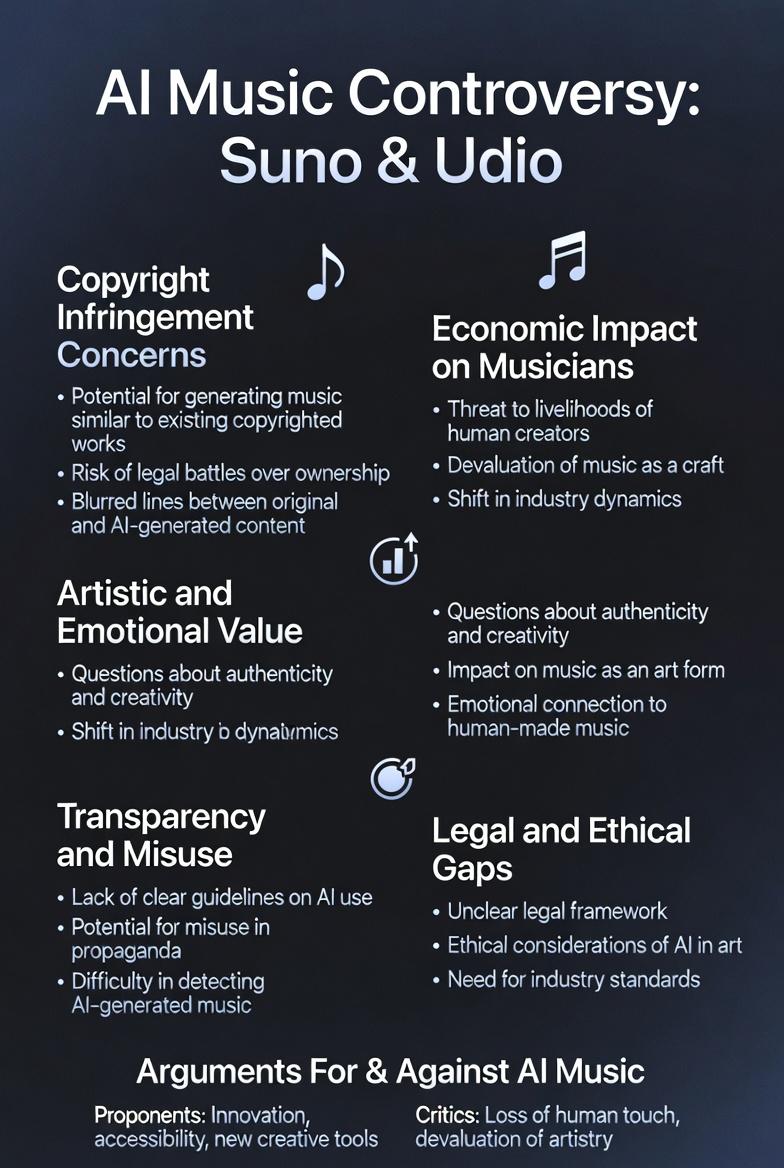
1. Copyright and Training Data
The most heated controversy revolves around how AI music models are trained. These systems learn from vast datasets that often include copyrighted works, frequently without explicit permission or compensation.
- Major record labels have filed lawsuits against AI music platforms
- Claims include unauthorized use of protected musical works
- The unresolved legal question: fair use or intellectual property theft?
2. Economic Impact on Musicians
Many professional musicians, composers and producers fear economic displacement, particularly in commercial fields such as stock music, jingles and background scores.
- AI-generated music increases competition at massive scale
- Infinite supply risks devaluing music as a paid craft
- Streaming income is already minimal for most artists
A Necessary Reality Check
An often overlooked aspect of this debate is who is actually speaking the loudest. Many of the most vocal critics of AI music are not struggling newcomers, but well-established artists, major labels and industry institutions that continue to earn substantial revenue from catalogs, touring and licensing.
This raises an uncomfortable but valid question: Is this truly about survival — or about preserving control and exclusivity?
While AI undeniably disrupts creative workflows, it is difficult to ignore that many top-tier artists will continue to earn a very comfortable living regardless. For them, AI represents less an existential threat and more a shift in power dynamics. Missing out on one luxury does not equate to losing one’s livelihood.
Meanwhile, the real vulnerability lies lower in the ecosystem: session musicians, freelance composers, library music creators and independent artists without legacy catalogs. Ironically, these groups were already underpaid long before AI entered the picture.
Framing the debate as “artists versus machines” oversimplifies reality. The core issue is not whether AI can create music, but whether its economic benefits are distributed fairly — and whether smaller creators are once again being sacrificed to protect the interests of those already at the top.
3. Artistic and Emotional Concerns
Music has traditionally been tied to lived experience, emotion and intention. Critics argue that AI lacks awareness, motivation and cultural context, raising concerns about authenticity and artistic depth.
4. Transparency and Misuse
Voice cloning and AI-generated artist impersonations are increasingly common. Without clear labeling standards, audiences may be misled about what is human-created versus machine-generated.
5. Legal and Ethical Gaps
Current legislation struggles to keep pace with rapid AI innovation. Ownership rights, responsibility and compensation frameworks remain unclear across most jurisdictions.
6. Why Suno Is at the Center of the Debate
Suno attracts particular attention not because it is uniquely unethical, but because it dramatically lowers the barrier to music creation and produces results that sound convincingly human.
Suno did not create the controversy — it accelerated it.
Arguments in Favor of AI Music
- Democratization of music creation for non-musicians
- AI as an inspiration and prototyping tool for professionals
- New hybrid genres and experimental workflows
The Core Conflict
This debate is not truly about software. It is about power, scale, ownership and meaning. Who controls creative output? Who profits from automation? And how do we preserve human value in an age of machine-generated art?
Community Discussion
We invite the MusiQloud community to share their views:
- Is AI music a threat, a tool, or both?
- Should artists be compensated for training data?
- Can AI and human creativity coexist without devaluing each other?
Respectful and thoughtful debate is encouraged.
Quick Poll
What best describes your position?
- AI music is a powerful creative tool
- AI music threatens human musicians
- AI music can coexist with fair regulation
- I’m still undecided

 Arabic
 French
 Spanish
 Portuguese
 Deutsch
 Turkish
 Dutch
Dutch
 Italiano
 Russian
 Romaian
 Portuguese (Brazil)
 Greek
Greek